Home - is where I want to be / But I guess I'm already there /I come home -
she lifted up her wings /
Guess that this must be the place...
- Talking Heads, "Naive Melody"

Monday, June 27, 2011

New England Tour 2011: Portland, Maine

Last weekend we were in Newport, RI for D*'s cousin's wedding. This past weekend we headed north for a long-anticipated visit with old friends. They moved into their house nearly three years ago, and we still hadn't been to see it.

Mission accomplished! The day did not start out promising--it looked pretty much the way it had for almost a solid week.


We piled into the van and made our way out of the city. The baby was not happy about being trussed into her car seat practically as soon as she woke up, and made her annoyance known before finally falling asleep. It rained the entire way up. We arrived just around noon, which meant that after a rapid tour we piled back into the van (hooray for passenger space) and headed into Portland, a city D* and I hadn't been to in ages, and which the kids have never seen. Goal: Lunch.

It was Lobsterfest. Despite the rain and low-60s temperatures, there was something resembling a turnout for it, which meant that we had to search for parking. The first restaurant we tried had a half hour wait, so we went around the corner to The Dry Dock. I had the crab melt, and it was delicious. L ordered chicken fingers and fries, and proceeded to eat one bite of each, alarmed by the unpeeled potatoes. J had a graham cracker. The baby ate her cereal and jarred veggies enthusiastically, in between turning around to stare at everyone else in the place.

Since it wasn't actually raining, we poked along the pier.


Then we decided to check out the Lobersterfest, two piers down. Unfortunately, if you weren't going to eat lobster, there wasn't much to see, but we did encounter some mild drama. A bunch of men were fishing off the end of the pier. One of them cast, and managed to get his line wrapped around a seagull. We figured the bird was done for, flapping hopelessly about in the water as it was, but wait! A fellow in a small launch motored over and after a couple of attempts, herded the critter over to the gangway (a word it has taken me 24 hours to bring to mind). The fisherman and a friend waited there. With commendable dexterity (and nerve), one of them grabbed the gull by the neck, and they got it disentangled and sent it on its way.

I'm not sure if this speaks to the human capacity for empathy with even such a useless creature as a seagull, or if he just really liked that lure.

We strolled about a bit longer, then headed back toward the car.


L had taken immediate note of the number of ice cream opportunities available even on such a short journey through Portland, and her behavior had been acceptable. A stop at Beal's was in order.


Then back to the house for Wii, catching up on life, and a lovely pasta dinner.

On the way back... it rained.

Sunday, June 26, 2011

The Heart of the Blogging Problem?

It may be that I don't have enough problems! I have the usual challenges of anyone with kids and a life, but there's nothing specific that I'm dealing with to provide a focus. I don't have to live on a low budget, cook gluten-free, avoid allergens, or get dinner on the table in 15 minutes or less (though it's always nice when I can). I know what I'm doing in the kitchen to a degree that satisfies me, and I don't want to be Thomas Keller.

I need more goals.

Friday, June 24, 2011

Idoru

I have read Idoru before. I could not tell you when that was -- probably shortly after it came out, since I have it in hardcover. I realized recently that I remember nothing about it, so when it came time to put a fresh book in the backpack, I plucked it from the shelf.

Reading fifteen-year-old SF is a great way to make yourself feel old. Remember the nineties, and what we thought the future was going to look like? Things never work out quite the way we thought they would, and not only in the jet-packs and household robots department. One of the most anachronistic things about this book is the idea of a fourteen-year-old who doesn't know what a love hotel is, not to mention an Internet so tame and compartmentalized, so disconnected from other people, missing most of its inter-ness. There are beautiful virtual landscapes everywhere, but with the exception of Walled City they are sterile.

Today, he would probably not feel compelled to define otaku, though he also might not set the book in Japan, which seems to have lost its place as the lodestone of the technoculture. He uses the word "fractal" several times. In the now that the imagined future turned into, we don't seem to be interested in the immersive virtual reality idea that so much SF of the late 20th century dealt in, though you can bet that I sat up and took notice when this story ran in Gizmodo during my reading.

Anyway. Turns out that the reason I don't remember what happens in the book is that for 200 pages, nothing much happens. Laney is immersed in mystery and Chia in a vague sense of threat; meanwhile, Gibson indulges in stylistic riffing, scattershot, fragmented moments of sensation and image that reflect a world sad and lost and confused, a world that doesn't know what it looks forward to any longer. Often, he can't be bothered with a complete sentence; I am left uncertain as to whether this was a choice, reflecting the characters' incomplete perception and experience of the world, or simple laziness.

I do feel compelled to mention that the name Slitscan is perfect, combining the clinical, invasive, and vaguely obscene, and is a stroke of genius, even if the character of Kathy Torrance is of dubious believability, given less depth than the titular idoru.

Or perhaps that's the point. It's difficult to tell purposeful from unintended irony any longer. Perhaps the book's overall thinness is part of the effect. Because after those first 200 pages, there is a flurry of activity, and then... next to nothing actually happens. The conflicts that barely appeared on screen are resolved with a negligent handwave. The characters go back to their lives. The point of the whole business remains hints whose fruition lies elusively in the future. The book reads like a lacework of notes draped across a scribbled skeleton of plot; like something that could have been reduced to a few chapters of another story, or even to a poem, stripped down to its images and feelings, a meditation on modernity and celebrity without the burden of narrative.

I'm likely to forget about it now that I've read it again.

Belay That?

I've given it some more thought, and I'm going to try to continue to keep this blog live after all. It doesn't cost anything, after all, and if no one reads it... oh well.

This has been a strange spring. It's been chilly and wet far more often than not; today I wore a jacket to work (it's almost July!), and I suspect that many of us are considering a change of career, perhaps something in the slug-farming field.

I am bored out of my skull at work, restless with the lack of challenge in my days, and less than happy with the changes that came with the acquisition. Outside of work, I seem to be exhausted all of the time, even when the kids sleep, and frequently grouchy. My usual optimism is nowhere to be found; I consider projects as a means of reviving my spirits, but stop short of undertaking them, because really what's the point? The world has no need of anything I am likely to produce. I am ambivalent about the entire Internet and seem to have lost faith in the whole idea of the world-wide conversation. Wary of engaging, alarmed by conflicts, and finding the entire business more a source of stress than of interest and pleasure, I dropped Twitter, dropped blogging, scaled back my Facebook activity. I switched my playlists to all-soothing, all the time. Work on the current novel has been reduced to occasionally opening the file and staring at the opening scene I was in the middle of rewriting.

I don't really like myself when I get like this. Even in a funk, I feel something of the problem-solving itch, which I suppose is all to the good. I'm trying to drink more water, taking some extra vitamin D, and if the weather hasn't improved by the time of my next paycheck, I'll buy a sunlamp. If that doesn't help, a trip to the doctor may be in order. Previous experience suggests that the thing to do when you're depressed is to the things that you enjoy when you're not depressed, and I have not been doing much of that.

Wednesday, May 18, 2011

Closing Down the Shop

Three years of inconsistent efforts later, I don't think there's much sense in keeping this blog up. I never did figure out what kind of blog it ought to be, which may be a metaphor for my somewhat scattered life, or just may reflect a lack of reflection. There's plenty of good reading out there.

Saturday, April 9, 2011

Follow-up: Setting the Hook

I'm going to continue with the analysis I started in my previous post, using the same two books to explore how the hook evolves into the opening of the story--the first page or so--and what gets accomplished in the first chunk of the book.

Though I didn't really think about it at the time I selected them, Swordspoint and God's War have some superficial similarities: both have main characters who are basically paid killers, both of them are first novels. The differences, however, are enormous, as we saw in their opening paragraphs, and each continues as it began.

God's War is divided into parts. Part 1: Bel Dame covers roughly the first 50 pages of the novel, so we'll use that length as our comparative point. A bel dame in the book's vernacular is the higher echelon of killers, distinguished from mere bounty hunters; they do important work, hunting down traitors and those who have returned from the war carrying dangerous contagions. The first few paragraphs after the hook set up the events of Part 1.


The first part of God's War consists of background and setting material interwoven with present-time information about Nyx working, using Jaks to track down a target. At the same time, she is trying to evade some old associates and enemies, who consider her as having violated the bel dame rules. Nyx gets her target, but she also gets caught, goes to prison, gets out, and forms a bounty hunter team--accepting this lower-status work as all she can get, turning some of her own hunters into members of her team. Seven years pass.

The passage of so much time with no detail at all makes me wonder why the story didn't start with Part 2. With the sole exception of a very brief, glancing contact with some Mysterious People, nothing that has happened so far seems to have major significance. Nyx is tough as nails; she has a sister (not close), a dead partner (de rigeur for hard-bitten types) and no scruples, ideals, or goals beyond staying alive. The other POV we've met, Rhys, is a foreigner from the enemy country, a former dancer, an indifferently talented magician willing to work for Nyx, and religious. His backstory provides potential conflicts that could be interesting, but so far they have not materialized.

After 50 pages, these characters have not become people, and I am only continuing to read this book for my own education.

Let's turn to our other paid killer, Richard St. Vier (names can say a lot, whether they have a real-world derivation or are based in a fictional language, whether they have surnames--it's a great way to imply without stating your setting). Swordspoint has several POV characters; the plot turns on conspiracy and betrayal, so the multiple voices have a role in making events comprehensible. Let's take a look at the rest of the opening.


Honestly? It gives me goosebumps. It could be argued that this lyrical opening is too slow, that it seeks to make a character of the landscape when it should be showing us the actual characters. As a reader, I'm inclined to let people get away with beauty for its own sake; others may be more strict.

This doesn't outline events; it gives a feel. 50 pages farther into Swordspoint, St. Vier has fought two duels. Like the Jaks business, these are non-plot events that serve to introduce Richard, his lover, the setting, and the entire cast of noble characters whose schemes against one another set the plot and subplots in motion (for such a short book, there are plenty of threads).

By contrast with God's War, after those fifty pages you have a sense of what each of these people wants. Whether it's power, challenge, sex, a hiding place, everyone is after something, and everyone faces obstacles to their desires. This, along with the variety in their goals, goes a long way toward making them realistic. The backgrounding takes a while, partly due to the size of the cast, but there are no extraneous players; the plot rises organically out of contact between people whose wants are in conflict.

A long-distant version of my first novel started with the birth of one of the main characters. For both of the MCs, I included childhoods and formative events, not quite grasping at the time that I was thereby writing a biography, not a plot, that the character's story was not The Story. Many painful revisions later, the first chapter of the book contains the first events in the actual plot.

God's War starts with a bang, then appears to lose its way in a maze of past perfect background and current events that seem insignificant. Swordspoint starts slowly, like a gardener sowing a varied handful of seeds to see what comes of them.

Where do you start your story? Where does the plot start? Do you find yourself having to backtrack a lot in time to lay background? Is that background playing a part in the plot, or just in your character's background?

Monday, April 4, 2011

Act I, Scene 1 - On Hooks

Last week I started writing a rant on the topic of writing advice I consider worse than useless: the do and don't lists on how to start your novel. This list from the Guardian went around the Twitter aspiring-author community like wildfire last year, and to some extent it still haunts the mental landscape.

Given the weekend to cool off, I no longer feel quite so ranty. (Never internet while angry.) I do feel like this is a topic that needs more attention and thought that can be provided by a series of checklists. I don't know if I'm the person to provide that, but I may as well give it a shot.

I am a technical writer by trade, and I am going to try looking at the First Paragraph from a functional perspective. Art is dynamic; it needs to do something in interaction with the audience (otherwise you may as well stare at the wall). The First Paragraph in a work of fiction has one overriding purpose: to make the reader read the second paragraph. One way to do this is by stimulating the reader's curiosity, and one way of doing that is with a "hook." As far as I can tell, a hook is a simple sentence that contains something startling.

I am not sure that the hook is essential. There are other ways to excite curiosity. I find myself wondering if, given all the crap they must have to wade through, agents and publishers don't end up putting an almost unnatural weight on that opening sentence, that opening paragraph. Speaking as a reader, I've read the jacket copy; I am prepared to believe that this book I am holding contains an interesting story. It does not actually need to grab me by the lapels and fling me into an action scene in order for me to believe that, any more than every movie has to start with a James Bond sequence. I am generally willing to give a book at least a few pages before I get impatient.

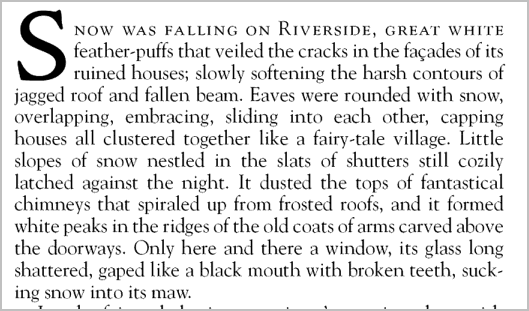
Which brings us back to function. Your first paragraph does something--an infinite number of somethings--to provide the reader entree to the story, to pique their curiosity. It can also serve to identify its intended audience and the story's overall tone. To illustrate, I am going to quote the first paragraph of one of my favorite books of all time, Ellen Kushner's Swordspoint.


By way of contrast, the book I am currently carrying around with me is Kameron Hurley's God's War.


These are very different openings. Is one approach good and the other bad?

I think we can all agree that God's War has quite a hook--it formally declares itself as such by setting the first sentence off in its own paragraph. More than inciting curiosity, however, it also sets a tone. This is going to be a book that treats its characters and its readers roughly. The language is bald and challenging. The place names along with the desert provide a hint as to the setting's roots. This is effective, compact use of language.

As for Swordspoint... Oh. My. God. Weather! And nothing is happening. It has no identifiable hook, and current wisdom, it seems, suggests that no reader would ever get past that paragraph. However--there is more going on in it than "it's winter." Description piles up (like the snow) in a series of contrasts to create tension that can only be eased by reading on:  feather-puffs/ruined, jagged/rounded, cozily/shattered. It builds a picture in your mind, promises more but makes you wait for it. The language tells you what kind of story this is going to be, that it is literary, romantic, indirect.

I think there is room in this universe for more than one approach to the opening paragraph. What do you think?