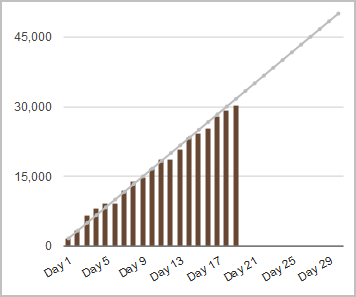
50,000 words, 29 days. A three-time winner is me:
It's a horrible draft even by NaNo standards, but it'll sit there in the queue until I have time to give it some proper thought. As long as I keep doing this every November, I will never be without a book to work on--assuming that I don't give up this entire hobby at some point as a ridiculous waste of time, as sometimes sounds like a good idea.
I have lots of food posts to do, and maybe now I will have time to write them.
Showing posts with label Fiction Writing. Show all posts
Tuesday, November 29, 2011
Saturday, November 19, 2011
30,000 Words Under the Sea
Or something like that. NaNoWriMo is... well, not exactly cruising along this year. It's been something of a struggle, though I've never been more than a day's wordcount behind. The story is pretty workmanlike at this point; I've got ideas for things I can do with it when the day comes to draft it properly--which I think I will do, though it's going to have to wait for Fury's Flight and then Go before it gets furnished. I could probably have just as well spent the time doing a proper outline and some research. On the other hand, I am coming up with some things along the way that I might not have if I were doing this more systematically. I guess I am halfway between pantsing and plotting.
Wednesday, October 19, 2011
Oh, Beta Readers....
I have ten of them signed up to read.
TEN.
My takeaway? That the story sounds different enough to be interesting, and that the first scene promises writing quality that will at least not be torture to endure for 92,000 words.
I have also gotten one very honest negative review of that scene. I can live with that. The book has been through two drafts, but this is just the start of its journey.
TEN.
My takeaway? That the story sounds different enough to be interesting, and that the first scene promises writing quality that will at least not be torture to endure for 92,000 words.
I have also gotten one very honest negative review of that scene. I can live with that. The book has been through two drafts, but this is just the start of its journey.
Tuesday, October 11, 2011
Third Draft: Done
It ended up being somewhat shorter than I had hoped, once I deleted all of the crap scenes I had moved to the end to figure out later. It is however complete, a coherent story from start to finish with no missing scenes or transitions or bits marked "figure this out later." Now to wait and see if anyone on critters.org wants to beta, and to start researching the next novel.
FURY'S FLIGHT
FURY'S FLIGHT
92,000/92,000
Friday, September 9, 2011
Monday, August 15, 2011
State of the Novel
I ought to use this space for accountability in writing as well as reading, now that I am finding my way back into the world of being productive. My WIP is a genre-blender with the working title Fury's Flight.
FURY'S FLIGHT
In addition, I have begun noodling about with ideas for this year's NaNoWriMo project (my third). Just a few notes and ideas, and an Amazon order placed for a book (used) that might be helpful in researching the setting. I have never had to do much research for a book before, so this will be interesting.
FURY'S FLIGHT
80,000/100,000
In addition, I have begun noodling about with ideas for this year's NaNoWriMo project (my third). Just a few notes and ideas, and an Amazon order placed for a book (used) that might be helpful in researching the setting. I have never had to do much research for a book before, so this will be interesting.
Saturday, April 9, 2011
Follow-up: Setting the Hook
I'm going to continue with the analysis I started in my previous post, using the same two books to explore how the hook evolves into the opening of the story--the first page or so--and what gets accomplished in the first chunk of the book.
Though I didn't really think about it at the time I selected them, Swordspoint and God's War have some superficial similarities: both have main characters who are basically paid killers, both of them are first novels. The differences, however, are enormous, as we saw in their opening paragraphs, and each continues as it began.
God's War is divided into parts. Part 1: Bel Dame covers roughly the first 50 pages of the novel, so we'll use that length as our comparative point. A bel dame in the book's vernacular is the higher echelon of killers, distinguished from mere bounty hunters; they do important work, hunting down traitors and those who have returned from the war carrying dangerous contagions. The first few paragraphs after the hook set up the events of Part 1.
The first part of God's War consists of background and setting material interwoven with present-time information about Nyx working, using Jaks to track down a target. At the same time, she is trying to evade some old associates and enemies, who consider her as having violated the bel dame rules. Nyx gets her target, but she also gets caught, goes to prison, gets out, and forms a bounty hunter team--accepting this lower-status work as all she can get, turning some of her own hunters into members of her team. Seven years pass.
The passage of so much time with no detail at all makes me wonder why the story didn't start with Part 2. With the sole exception of a very brief, glancing contact with some Mysterious People, nothing that has happened so far seems to have major significance. Nyx is tough as nails; she has a sister (not close), a dead partner (de rigeur for hard-bitten types) and no scruples, ideals, or goals beyond staying alive. The other POV we've met, Rhys, is a foreigner from the enemy country, a former dancer, an indifferently talented magician willing to work for Nyx, and religious. His backstory provides potential conflicts that could be interesting, but so far they have not materialized.
After 50 pages, these characters have not become people, and I am only continuing to read this book for my own education.
Let's turn to our other paid killer, Richard St. Vier (names can say a lot, whether they have a real-world derivation or are based in a fictional language, whether they have surnames--it's a great way to imply without stating your setting). Swordspoint has several POV characters; the plot turns on conspiracy and betrayal, so the multiple voices have a role in making events comprehensible. Let's take a look at the rest of the opening.
Honestly? It gives me goosebumps. It could be argued that this lyrical opening is too slow, that it seeks to make a character of the landscape when it should be showing us the actual characters. As a reader, I'm inclined to let people get away with beauty for its own sake; others may be more strict.
This doesn't outline events; it gives a feel. 50 pages farther into Swordspoint, St. Vier has fought two duels. Like the Jaks business, these are non-plot events that serve to introduce Richard, his lover, the setting, and the entire cast of noble characters whose schemes against one another set the plot and subplots in motion (for such a short book, there are plenty of threads).
By contrast with God's War, after those fifty pages you have a sense of what each of these people wants. Whether it's power, challenge, sex, a hiding place, everyone is after something, and everyone faces obstacles to their desires. This, along with the variety in their goals, goes a long way toward making them realistic. The backgrounding takes a while, partly due to the size of the cast, but there are no extraneous players; the plot rises organically out of contact between people whose wants are in conflict.
A long-distant version of my first novel started with the birth of one of the main characters. For both of the MCs, I included childhoods and formative events, not quite grasping at the time that I was thereby writing a biography, not a plot, that the character's story was not The Story. Many painful revisions later, the first chapter of the book contains the first events in the actual plot.
God's War starts with a bang, then appears to lose its way in a maze of past perfect background and current events that seem insignificant. Swordspoint starts slowly, like a gardener sowing a varied handful of seeds to see what comes of them.
Where do you start your story? Where does the plot start? Do you find yourself having to backtrack a lot in time to lay background? Is that background playing a part in the plot, or just in your character's background?
Though I didn't really think about it at the time I selected them, Swordspoint and God's War have some superficial similarities: both have main characters who are basically paid killers, both of them are first novels. The differences, however, are enormous, as we saw in their opening paragraphs, and each continues as it began.
God's War is divided into parts. Part 1: Bel Dame covers roughly the first 50 pages of the novel, so we'll use that length as our comparative point. A bel dame in the book's vernacular is the higher echelon of killers, distinguished from mere bounty hunters; they do important work, hunting down traitors and those who have returned from the war carrying dangerous contagions. The first few paragraphs after the hook set up the events of Part 1.
The first part of God's War consists of background and setting material interwoven with present-time information about Nyx working, using Jaks to track down a target. At the same time, she is trying to evade some old associates and enemies, who consider her as having violated the bel dame rules. Nyx gets her target, but she also gets caught, goes to prison, gets out, and forms a bounty hunter team--accepting this lower-status work as all she can get, turning some of her own hunters into members of her team. Seven years pass.
The passage of so much time with no detail at all makes me wonder why the story didn't start with Part 2. With the sole exception of a very brief, glancing contact with some Mysterious People, nothing that has happened so far seems to have major significance. Nyx is tough as nails; she has a sister (not close), a dead partner (de rigeur for hard-bitten types) and no scruples, ideals, or goals beyond staying alive. The other POV we've met, Rhys, is a foreigner from the enemy country, a former dancer, an indifferently talented magician willing to work for Nyx, and religious. His backstory provides potential conflicts that could be interesting, but so far they have not materialized.
After 50 pages, these characters have not become people, and I am only continuing to read this book for my own education.
Let's turn to our other paid killer, Richard St. Vier (names can say a lot, whether they have a real-world derivation or are based in a fictional language, whether they have surnames--it's a great way to imply without stating your setting). Swordspoint has several POV characters; the plot turns on conspiracy and betrayal, so the multiple voices have a role in making events comprehensible. Let's take a look at the rest of the opening.
Honestly? It gives me goosebumps. It could be argued that this lyrical opening is too slow, that it seeks to make a character of the landscape when it should be showing us the actual characters. As a reader, I'm inclined to let people get away with beauty for its own sake; others may be more strict.
This doesn't outline events; it gives a feel. 50 pages farther into Swordspoint, St. Vier has fought two duels. Like the Jaks business, these are non-plot events that serve to introduce Richard, his lover, the setting, and the entire cast of noble characters whose schemes against one another set the plot and subplots in motion (for such a short book, there are plenty of threads).
By contrast with God's War, after those fifty pages you have a sense of what each of these people wants. Whether it's power, challenge, sex, a hiding place, everyone is after something, and everyone faces obstacles to their desires. This, along with the variety in their goals, goes a long way toward making them realistic. The backgrounding takes a while, partly due to the size of the cast, but there are no extraneous players; the plot rises organically out of contact between people whose wants are in conflict.
A long-distant version of my first novel started with the birth of one of the main characters. For both of the MCs, I included childhoods and formative events, not quite grasping at the time that I was thereby writing a biography, not a plot, that the character's story was not The Story. Many painful revisions later, the first chapter of the book contains the first events in the actual plot.
God's War starts with a bang, then appears to lose its way in a maze of past perfect background and current events that seem insignificant. Swordspoint starts slowly, like a gardener sowing a varied handful of seeds to see what comes of them.
Where do you start your story? Where does the plot start? Do you find yourself having to backtrack a lot in time to lay background? Is that background playing a part in the plot, or just in your character's background?
Monday, April 4, 2011
Act I, Scene 1 - On Hooks
Last week I started writing a rant on the topic of writing advice I consider worse than useless: the do and don't lists on how to start your novel. This list from the Guardian went around the Twitter aspiring-author community like wildfire last year, and to some extent it still haunts the mental landscape.
Given the weekend to cool off, I no longer feel quite so ranty. (Never internet while angry.) I do feel like this is a topic that needs more attention and thought that can be provided by a series of checklists. I don't know if I'm the person to provide that, but I may as well give it a shot.
I am a technical writer by trade, and I am going to try looking at the First Paragraph from a functional perspective. Art is dynamic; it needs to do something in interaction with the audience (otherwise you may as well stare at the wall). The First Paragraph in a work of fiction has one overriding purpose: to make the reader read the second paragraph. One way to do this is by stimulating the reader's curiosity, and one way of doing that is with a "hook." As far as I can tell, a hook is a simple sentence that contains something startling.
I am not sure that the hook is essential. There are other ways to excite curiosity. I find myself wondering if, given all the crap they must have to wade through, agents and publishers don't end up putting an almost unnatural weight on that opening sentence, that opening paragraph. Speaking as a reader, I've read the jacket copy; I am prepared to believe that this book I am holding contains an interesting story. It does not actually need to grab me by the lapels and fling me into an action scene in order for me to believe that, any more than every movie has to start with a James Bond sequence. I am generally willing to give a book at least a few pages before I get impatient.
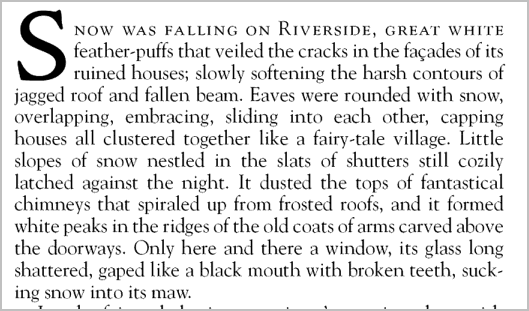
Which brings us back to function. Your first paragraph does something--an infinite number of somethings--to provide the reader entree to the story, to pique their curiosity. It can also serve to identify its intended audience and the story's overall tone. To illustrate, I am going to quote the first paragraph of one of my favorite books of all time, Ellen Kushner's Swordspoint.
By way of contrast, the book I am currently carrying around with me is Kameron Hurley's God's War.
These are very different openings. Is one approach good and the other bad?
I think we can all agree that God's War has quite a hook--it formally declares itself as such by setting the first sentence off in its own paragraph. More than inciting curiosity, however, it also sets a tone. This is going to be a book that treats its characters and its readers roughly. The language is bald and challenging. The place names along with the desert provide a hint as to the setting's roots. This is effective, compact use of language.
As for Swordspoint... Oh. My. God. Weather! And nothing is happening. It has no identifiable hook, and current wisdom, it seems, suggests that no reader would ever get past that paragraph. However--there is more going on in it than "it's winter." Description piles up (like the snow) in a series of contrasts to create tension that can only be eased by reading on: feather-puffs/ruined, jagged/rounded, cozily/shattered. It builds a picture in your mind, promises more but makes you wait for it. The language tells you what kind of story this is going to be, that it is literary, romantic, indirect.
I think there is room in this universe for more than one approach to the opening paragraph. What do you think?
Given the weekend to cool off, I no longer feel quite so ranty. (Never internet while angry.) I do feel like this is a topic that needs more attention and thought that can be provided by a series of checklists. I don't know if I'm the person to provide that, but I may as well give it a shot.
I am a technical writer by trade, and I am going to try looking at the First Paragraph from a functional perspective. Art is dynamic; it needs to do something in interaction with the audience (otherwise you may as well stare at the wall). The First Paragraph in a work of fiction has one overriding purpose: to make the reader read the second paragraph. One way to do this is by stimulating the reader's curiosity, and one way of doing that is with a "hook." As far as I can tell, a hook is a simple sentence that contains something startling.
I am not sure that the hook is essential. There are other ways to excite curiosity. I find myself wondering if, given all the crap they must have to wade through, agents and publishers don't end up putting an almost unnatural weight on that opening sentence, that opening paragraph. Speaking as a reader, I've read the jacket copy; I am prepared to believe that this book I am holding contains an interesting story. It does not actually need to grab me by the lapels and fling me into an action scene in order for me to believe that, any more than every movie has to start with a James Bond sequence. I am generally willing to give a book at least a few pages before I get impatient.
Which brings us back to function. Your first paragraph does something--an infinite number of somethings--to provide the reader entree to the story, to pique their curiosity. It can also serve to identify its intended audience and the story's overall tone. To illustrate, I am going to quote the first paragraph of one of my favorite books of all time, Ellen Kushner's Swordspoint.
By way of contrast, the book I am currently carrying around with me is Kameron Hurley's God's War.
These are very different openings. Is one approach good and the other bad?
I think we can all agree that God's War has quite a hook--it formally declares itself as such by setting the first sentence off in its own paragraph. More than inciting curiosity, however, it also sets a tone. This is going to be a book that treats its characters and its readers roughly. The language is bald and challenging. The place names along with the desert provide a hint as to the setting's roots. This is effective, compact use of language.
As for Swordspoint... Oh. My. God. Weather! And nothing is happening. It has no identifiable hook, and current wisdom, it seems, suggests that no reader would ever get past that paragraph. However--there is more going on in it than "it's winter." Description piles up (like the snow) in a series of contrasts to create tension that can only be eased by reading on: feather-puffs/ruined, jagged/rounded, cozily/shattered. It builds a picture in your mind, promises more but makes you wait for it. The language tells you what kind of story this is going to be, that it is literary, romantic, indirect.
I think there is room in this universe for more than one approach to the opening paragraph. What do you think?
Wednesday, March 30, 2011
Limited vs Open-Ended Series
I don't often get up on a high horse and talk about writing topics, because really, who the hell cares what I think? But I've run across this topic on two blogs in the past week, and it's starting to make me crazy, so I'll blather for a while.
The posts were on the topic of writing a series, and what both of them did was gloss blithely over the inherent difference between a limited and an open-ended series, equating Harry Potter with various mystery/thriller series without ever taking note of the fact that they are comparing two different creatures. And the thing that makes a limited series different is something that is very near and dear to me: THE END.
A limited series has AN ending; it structures itself around that fact. Each part of the story evolves some distance toward that point, usually with an ascending sequence of climaxes that have the same overall rhythm as any single volume. All of the plots go to the same place. Because the previous volumes are essential--it's all one--you can limit the amount of refresher information you give readers, or section it off in an introduction. It is expected that characters, even the world will suffer major changes; that is kind of the point.
An open series has MANY endings; each book has its own. Each book's climax tends to be at the same pitch, and each new volume hits the emotional reset button. Without an end to aim for, subplots tend to proliferate; killing them off becomes a major commitment, deep-sixing a resource that could be used in future books. Either every book has an all-new major antagonist, or the major antagonist is hidden in the shadows and only his or her catspaws are defeated. The main character tends to be the draw for the entire series; therefore, it's difficult to make substantial changes to the character. Since you never know when you might pick up readers, there tends to be repeated descriptive information for new fans who don't know what the main character looks like, or what kind of car is the villain's signature.
In case you can't tell, I have very little use for open-ended series; it's one reason I hate most television (major exception: Babylon 5. Guess why.) A story that has no destination is doomed to lose its way and drown in a bog, and by the time it does that, no one will miss it.
FURY'S FLIGHT
The posts were on the topic of writing a series, and what both of them did was gloss blithely over the inherent difference between a limited and an open-ended series, equating Harry Potter with various mystery/thriller series without ever taking note of the fact that they are comparing two different creatures. And the thing that makes a limited series different is something that is very near and dear to me: THE END.
A limited series has AN ending; it structures itself around that fact. Each part of the story evolves some distance toward that point, usually with an ascending sequence of climaxes that have the same overall rhythm as any single volume. All of the plots go to the same place. Because the previous volumes are essential--it's all one--you can limit the amount of refresher information you give readers, or section it off in an introduction. It is expected that characters, even the world will suffer major changes; that is kind of the point.
An open series has MANY endings; each book has its own. Each book's climax tends to be at the same pitch, and each new volume hits the emotional reset button. Without an end to aim for, subplots tend to proliferate; killing them off becomes a major commitment, deep-sixing a resource that could be used in future books. Either every book has an all-new major antagonist, or the major antagonist is hidden in the shadows and only his or her catspaws are defeated. The main character tends to be the draw for the entire series; therefore, it's difficult to make substantial changes to the character. Since you never know when you might pick up readers, there tends to be repeated descriptive information for new fans who don't know what the main character looks like, or what kind of car is the villain's signature.
In case you can't tell, I have very little use for open-ended series; it's one reason I hate most television (major exception: Babylon 5. Guess why.) A story that has no destination is doomed to lose its way and drown in a bog, and by the time it does that, no one will miss it.
FURY'S FLIGHT
70,000/100,000
Monday, February 14, 2011
Core Characteristics and Emergent Properties
As usual, I have no idea how this train of thought came about, but a few weeks ago I started thinking about the core characteristic of each of my main characters, what it is that makes them uniquely themselves. For Brandon, it's duality--not just bisexuality, which is rather obvious, but his ability to move between the court and the lower city, to share foreign and home perspectives, to understand magic without being of it. Kevan took a lot longer to figure out, and the answer surprised me, because I'm pretty sure it's love. Not exactly something I planned to put into his character, but on examination, most of what he does can be traced back to that. For the new book, I'm not entirely sure yet.
That it takes a while to figure out struck me on reflection as a good thing. You want a character to be complex, to have if possible all of the inner confusions and contradictions of a real person. If you set out to write someone thinking, "this person is ambition" or whatever, you're going to wind up with cardboard, because real people don't act the same way all the time. Ask anyone to describe themselves in one word and they're likely to fidget a lot, come up with something, and then add "but" to whatever they said.
I think that this notion of a core characteristic is something that should emerge as you get to know the characters, and it's not likely to make itself known in the first draft. Once it comes out, you can shine it up in a few places if you want to, or leave it as an exercise to your future readers to argue about; if you can't come up with anything at all, though, after several drafts, that might mean that your character is not drawn clearly, or isn't being active enough to demonstrate their qualities.
FURY'S FLIGHT
That it takes a while to figure out struck me on reflection as a good thing. You want a character to be complex, to have if possible all of the inner confusions and contradictions of a real person. If you set out to write someone thinking, "this person is ambition" or whatever, you're going to wind up with cardboard, because real people don't act the same way all the time. Ask anyone to describe themselves in one word and they're likely to fidget a lot, come up with something, and then add "but" to whatever they said.
I think that this notion of a core characteristic is something that should emerge as you get to know the characters, and it's not likely to make itself known in the first draft. Once it comes out, you can shine it up in a few places if you want to, or leave it as an exercise to your future readers to argue about; if you can't come up with anything at all, though, after several drafts, that might mean that your character is not drawn clearly, or isn't being active enough to demonstrate their qualities.
FURY'S FLIGHT
13,191/100,000
Wednesday, February 2, 2011
It Can Stop Snowing Now
Music: The Mollys, This Is My Round
I think there will be many a cup of tea drunk today. I made it to the office yesterday, but I didn't have much company there, and it was a long, cold wait for the bus home. I feel sad when it doesn't snow all winter, but this is officially ridiculous. Schools are closed, so I'll be working at the desk in the bedroom with my headphones in while D* plays Mario to entertain the kids. I thought the Wii would come in handy during snowy days, but I didn't expect it to get quite such a workout.
I have been looking around for a progress widget. This one comes from Inkalicious. It might do (not sure this will be a 100k book yet though - maybe 90k).
I think there will be many a cup of tea drunk today. I made it to the office yesterday, but I didn't have much company there, and it was a long, cold wait for the bus home. I feel sad when it doesn't snow all winter, but this is officially ridiculous. Schools are closed, so I'll be working at the desk in the bedroom with my headphones in while D* plays Mario to entertain the kids. I thought the Wii would come in handy during snowy days, but I didn't expect it to get quite such a workout.
I have been looking around for a progress widget. This one comes from Inkalicious. It might do (not sure this will be a 100k book yet though - maybe 90k).
Friday, January 28, 2011
Found Words
Looking through Google Docs, which I use off and on, I came upon this three-year-old fragment. What's a blog for if not for publishing things one finds in odd corners?
Once upon a time there was a woman who wouldn't write. She was daily beset by fearful imaginings, and hesitated to give them even mediated life through the page. She was also an incorrigible editor. The merest sentence, should it be written, would be fodder for a hundred or more rewrites. Surely to write badly was worse than not writing at all? There were too many bad writers in the world, what need to add to their number? Melodramatic, infantile, without redeeming merits, escapist, a cherisher of the familiar who knew that she would blaze no new paths, only tidy the borders of ancient gardens a bit, if that much. Was there any value in that to the world? To herself? What if, after some time of tidying, it turned out that she might after all find some new flower growing to one side of the path? It was then that the thorns of Time would rise up and wind around her ankles, drawing blood.
The cat stared intently at a sound. It could have been the house settling, or a child moving in its sleep. It could be something worse....
Wednesday, January 19, 2011
Writing Update - Ups, Downs, and Alongs
"Ups and downs" meaning that I have started the uniquely masochistic process known as querying agents. I have sent out five queries, gotten one form rejection and one request for the first five pages. I have heard that this agent requests many partials which are later rejected, but it gives me hope that my basic query letter and synopsis are acceptably written.
For the record, it feels exactly like getting a call-back on a resume: elation, followed by anxiety that I'll screw it up through an elementary error, followed by a reminder to myself that often these things don't work out, and it's no one's fault. I've done a fair amount of job-hunting in my life, been to many an interview that didn't pan out. I can handle this. The threat of rejection brings out my inner teenager, but of course one can't let that old version of oneself call the shots.
For the "alongs," I am working more earnestly on Fury's Flight. I am not sure whether I will try the entire snowflake process. Filling in spreadsheets is not my idea of a good time. I had a few ideas last night, and I think I've got a way to fill in the plot hole the book plunged into as I was finishing NaNoWriMo that year. I'm anxious to get with the words.
For the record, it feels exactly like getting a call-back on a resume: elation, followed by anxiety that I'll screw it up through an elementary error, followed by a reminder to myself that often these things don't work out, and it's no one's fault. I've done a fair amount of job-hunting in my life, been to many an interview that didn't pan out. I can handle this. The threat of rejection brings out my inner teenager, but of course one can't let that old version of oneself call the shots.
For the "alongs," I am working more earnestly on Fury's Flight. I am not sure whether I will try the entire snowflake process. Filling in spreadsheets is not my idea of a good time. I had a few ideas last night, and I think I've got a way to fill in the plot hole the book plunged into as I was finishing NaNoWriMo that year. I'm anxious to get with the words.
Monday, January 17, 2011
Writing Update
Important step on that "real writer" business today--I sent off a query email to an agent. Still makes me feel sick, but it has to get done.
Last night I finally opened the two crits I have on the first chapter of Fury's Flight, and found some very useful commentary and suggestions. I will probably have to axe the initial scene, but it's only a couple of pages. Better than axing 16 years of backstory like I had to last time.
I've started writing down the FF plot on index cards, looking for places I can add to it. There's a lot of digging to do if I'm going to make it the book I think it could be. For the moment, I think I will try to just get all of the events in place.
Last night I finally opened the two crits I have on the first chapter of Fury's Flight, and found some very useful commentary and suggestions. I will probably have to axe the initial scene, but it's only a couple of pages. Better than axing 16 years of backstory like I had to last time.
I've started writing down the FF plot on index cards, looking for places I can add to it. There's a lot of digging to do if I'm going to make it the book I think it could be. For the moment, I think I will try to just get all of the events in place.
Sunday, January 2, 2011
Gearing Up for the New Year
The office last week was tomb-like, a handful of us sprinkled through the big room, trading "sure is quiet" "yep, sure is" comments when we passed. I have been tidying up old projects and giving some thought to new ones. Home has been noisier, but with nothing much going on in terms of the holiday. It's been an exciting year, and we just weren't ready yet to go out and do anything major.
The Weekly Recipe Project is giving me trouble; when I look at it under that name, it seems impossibly limited. Only 52 recipes? I probably have that many online recipes bookmarked, never mind a hundred-odd cookbooks and binders of clippings. How to approach the task of selecting my pool? I browse through blogs, look at files I have saved for years, visualize my bookshelves. Perhaps I should restrict the project to soup recipes, or bread, or desserts? Take one recipe from a different cookbook every week?
I was up early New Years day--for creatures that sleep so damn much themselves, cats don't grasp the idea of sleeping in--and decided to get the grocery list/menu planning out of the way. I already had one new recipe lined up for later in the week, but in the spirit of starting the new year right, I grabbed my new copy of At Home with Madhur Jaffrey and started with the fish chapter.
I made this pretty much as written, except I don't have any asefetida and my fenugreek is ground, not whole. I added more cayenne than specified, but that was by mistake--the result was intensely hot, and made me wish I had some naan. I served this with rice alone, but it would make a nice component in a multi-course meal. It came together quickly and without much fussing, and made a nice change from my usual fish standbys.
Fish and Peas in a Fennel-Fenugreek Sauce
1 lb fillet of cod, hake, or halibut, 1/2 to 3/4 inch thick
1 tsp salt, divided
pepper
1/2 tsp cayenne, divided
1/8 tsp ground turmeric
3 Tbsp mustard, olive, or canola oil
1/8 tsp ground asafetida
1/4 tsp whole mustard seeds
1/2 tsp whole cumin seeds
1/4 tsp whole fennel seeds
1/8 tsp whole fenugreek seeds
3 Tbsp plain yogurt
4 medium tomatoes, coarsely grated (I used a can of tomato sauce)
1 c fresh or frozen and defrosted peas
** I added the peas near the end. Why would you cook peas for 10 minutes?
No pictures because my five-year-old camera died last week. I am trying to decide between size and features with a new one.
I am in the middle of a four-day weekend, trying to get the place back to some semblance of normality. More tidying than cleaning, trying to find homes for new things and continue whittling down the old.
On other resolution-related fronts, I sent Empire off to Dragon Moon Press, which was having an open sub month, and have put together a list of agents to query. The first chapter of Fury's Flight went to the writing group for crit, though I haven't psyched myself up sufficiently to read the feedback yet.
The Weekly Recipe Project is giving me trouble; when I look at it under that name, it seems impossibly limited. Only 52 recipes? I probably have that many online recipes bookmarked, never mind a hundred-odd cookbooks and binders of clippings. How to approach the task of selecting my pool? I browse through blogs, look at files I have saved for years, visualize my bookshelves. Perhaps I should restrict the project to soup recipes, or bread, or desserts? Take one recipe from a different cookbook every week?
I was up early New Years day--for creatures that sleep so damn much themselves, cats don't grasp the idea of sleeping in--and decided to get the grocery list/menu planning out of the way. I already had one new recipe lined up for later in the week, but in the spirit of starting the new year right, I grabbed my new copy of At Home with Madhur Jaffrey and started with the fish chapter.
I made this pretty much as written, except I don't have any asefetida and my fenugreek is ground, not whole. I added more cayenne than specified, but that was by mistake--the result was intensely hot, and made me wish I had some naan. I served this with rice alone, but it would make a nice component in a multi-course meal. It came together quickly and without much fussing, and made a nice change from my usual fish standbys.
Fish and Peas in a Fennel-Fenugreek Sauce
1 lb fillet of cod, hake, or halibut, 1/2 to 3/4 inch thick
1 tsp salt, divided
pepper
1/2 tsp cayenne, divided
1/8 tsp ground turmeric
3 Tbsp mustard, olive, or canola oil
1/8 tsp ground asafetida
1/4 tsp whole mustard seeds
1/2 tsp whole cumin seeds
1/4 tsp whole fennel seeds
1/8 tsp whole fenugreek seeds
3 Tbsp plain yogurt
4 medium tomatoes, coarsely grated (I used a can of tomato sauce)
1 c fresh or frozen and defrosted peas
- Sprinkle the fish on both sides with 1/4 tsp salt, freshly ground black pepper, 1/4 tsp cayenne, and the turmeric. Set aside 30 minutes or longer, refrigerating if necessary.
- Put the oil in a frying pan and set on medium-high. Put in the asafetida, then the mustard, cumin, fennel, and fenugreek seeds.
- As soon as the mustard seeds start to pop, add the yogurt. Stir until it almost disappears.*
- Add the tomatoes, 3/4 tsp salt, 1/4 tsp cayenne, and more pepper if desired. Stir and cook for five minutes, until tomatoes thicken slightly.
- Add the peas, stir, and continue to cook another minute on medium heat.**
- Lay the fish down in the sauce. Spoon the sauce over the fish and bring to a simmer. Partially cover and poach fish on medium-low heat until just cooked through, 7-10 minutes. Add water if the pan dries out.
** I added the peas near the end. Why would you cook peas for 10 minutes?
No pictures because my five-year-old camera died last week. I am trying to decide between size and features with a new one.
I am in the middle of a four-day weekend, trying to get the place back to some semblance of normality. More tidying than cleaning, trying to find homes for new things and continue whittling down the old.
On other resolution-related fronts, I sent Empire off to Dragon Moon Press, which was having an open sub month, and have put together a list of agents to query. The first chapter of Fury's Flight went to the writing group for crit, though I haven't psyched myself up sufficiently to read the feedback yet.
Labels:
Fiction Writing,
Fish,
Indian,
Madhur Jaffrey,
Three Stars
Wednesday, December 1, 2010
Wednesday, May 12, 2010
Where Does the Time Go?
I had a vague thought this morning that I hadn't blogged for a while. I had no idea it had been nearly two weeks! Time goes by awfully fast when you're apartment-hunting and pregnant and trying to finish a novel. The only new recipe I've tried in the past couple of weeks turned out badly, so I don't want to blog it. Instead, a quick up update on Empire -- I've made it through chapter 8 in the latest bout of restructuring. This is about 1/3 of the way through the book, and the point at which things really start going badly--shadowy threats manifest, poor decisions are made. Fun times.
Wednesday, April 28, 2010
To Do
Write.
Exercise.
Drink plenty of water.
Cook and eat nutritious, homemade meals.
Get eight hours of sleep.
Earn a paycheck.
Blog insightfully.
Meditate.
Network.
Tweet.
Value friends and family.
Read work in your field.
Read work outside your field.
Comment insightfully on other blogs.
Research current/future novels.
Research agents.
Research publishers.
Attend conferences (for career).
Attend conferences (for writing).
Critique others' writing.
Write some more.
Exercise.
Drink plenty of water.
Cook and eat nutritious, homemade meals.
Get eight hours of sleep.
Earn a paycheck.
Blog insightfully.
Meditate.
Network.
Tweet.
Value friends and family.
Read work in your field.
Read work outside your field.
Comment insightfully on other blogs.
Research current/future novels.
Research agents.
Research publishers.
Attend conferences (for career).
Attend conferences (for writing).
Critique others' writing.
Write some more.
Sunday, January 24, 2010
Happy, Happy, Happy!!!
Yesterday I got a crit on the entire Book 1 draft. It was from someone whose work I had read a week or so back (we had agreed to do a swap); I was very impressed by her writing, and so nervous about what she might think of mine that I went off and did housework instead of reading her feedback.
This morning I finally opened the file. She wasn't shy about pointing out the problems, but she also said such positive things that I am in, I don't know, a state of shock? This is someone who is under no obligation to be nice to me, offering an opinion that I am capable of writing publishable work*, that the novel has issues but it also has merit. I am either going to cry or sing. :)
*It does not of course follow that it ever will be, but hey -- can't hurt.
This morning I finally opened the file. She wasn't shy about pointing out the problems, but she also said such positive things that I am in, I don't know, a state of shock? This is someone who is under no obligation to be nice to me, offering an opinion that I am capable of writing publishable work*, that the novel has issues but it also has merit. I am either going to cry or sing. :)
*It does not of course follow that it ever will be, but hey -- can't hurt.
Wednesday, January 6, 2010
Writing Progress Report
Having done almost nothing tangible on any novel during my 10 days off for the holidays, I have finally started work on Book 3 in something resembling earnest. I say nothing tangible because I did in that time consider, fall in love with, and then discard several ideas for how to handle the midbook. I think I have a version of the story I can live with for a first draft now.
As of this post, I have hit 25,000 words. If I average a thousand words a day, I'll have a draft by the end of March. I have started putting my wordcount in my desk calendar as a means to encourage myself toward this goal.
I have also printed out all of the crits received so far on Book 1, so that I may attempt to fix all of the problems with the opening, while worrying ceaselessly that I have a screwed-up, useless story. Meanwhile, Real Job is presenting me with what I like to call "challenges." Think positive, and all that.
There are days when I feel overwhelmed by all of this, but on the whole, I love my life. :)
As of this post, I have hit 25,000 words. If I average a thousand words a day, I'll have a draft by the end of March. I have started putting my wordcount in my desk calendar as a means to encourage myself toward this goal.
I have also printed out all of the crits received so far on Book 1, so that I may attempt to fix all of the problems with the opening, while worrying ceaselessly that I have a screwed-up, useless story. Meanwhile, Real Job is presenting me with what I like to call "challenges." Think positive, and all that.
There are days when I feel overwhelmed by all of this, but on the whole, I love my life. :)
Subscribe to:
Posts (Atom)