Wednesday, May 18, 2011
Closing Down the Shop
Three years of inconsistent efforts later, I don't think there's much sense in keeping this blog up. I never did figure out what kind of blog it ought to be, which may be a metaphor for my somewhat scattered life, or just may reflect a lack of reflection. There's plenty of good reading out there.


Saturday, April 9, 2011
Follow-up: Setting the Hook
I'm going to continue with the analysis I started in my previous post, using the same two books to explore how the hook evolves into the opening of the story--the first page or so--and what gets accomplished in the first chunk of the book.
Though I didn't really think about it at the time I selected them, Swordspoint and God's War have some superficial similarities: both have main characters who are basically paid killers, both of them are first novels. The differences, however, are enormous, as we saw in their opening paragraphs, and each continues as it began.
God's War is divided into parts. Part 1: Bel Dame covers roughly the first 50 pages of the novel, so we'll use that length as our comparative point. A bel dame in the book's vernacular is the higher echelon of killers, distinguished from mere bounty hunters; they do important work, hunting down traitors and those who have returned from the war carrying dangerous contagions. The first few paragraphs after the hook set up the events of Part 1.

The first part of God's War consists of background and setting material interwoven with present-time information about Nyx working, using Jaks to track down a target. At the same time, she is trying to evade some old associates and enemies, who consider her as having violated the bel dame rules. Nyx gets her target, but she also gets caught, goes to prison, gets out, and forms a bounty hunter team--accepting this lower-status work as all she can get, turning some of her own hunters into members of her team. Seven years pass.
The passage of so much time with no detail at all makes me wonder why the story didn't start with Part 2. With the sole exception of a very brief, glancing contact with some Mysterious People, nothing that has happened so far seems to have major significance. Nyx is tough as nails; she has a sister (not close), a dead partner (de rigeur for hard-bitten types) and no scruples, ideals, or goals beyond staying alive. The other POV we've met, Rhys, is a foreigner from the enemy country, a former dancer, an indifferently talented magician willing to work for Nyx, and religious. His backstory provides potential conflicts that could be interesting, but so far they have not materialized.
After 50 pages, these characters have not become people, and I am only continuing to read this book for my own education.
Let's turn to our other paid killer, Richard St. Vier (names can say a lot, whether they have a real-world derivation or are based in a fictional language, whether they have surnames--it's a great way to imply without stating your setting). Swordspoint has several POV characters; the plot turns on conspiracy and betrayal, so the multiple voices have a role in making events comprehensible. Let's take a look at the rest of the opening.


Honestly? It gives me goosebumps. It could be argued that this lyrical opening is too slow, that it seeks to make a character of the landscape when it should be showing us the actual characters. As a reader, I'm inclined to let people get away with beauty for its own sake; others may be more strict.
This doesn't outline events; it gives a feel. 50 pages farther into Swordspoint, St. Vier has fought two duels. Like the Jaks business, these are non-plot events that serve to introduce Richard, his lover, the setting, and the entire cast of noble characters whose schemes against one another set the plot and subplots in motion (for such a short book, there are plenty of threads).
By contrast with God's War, after those fifty pages you have a sense of what each of these people wants. Whether it's power, challenge, sex, a hiding place, everyone is after something, and everyone faces obstacles to their desires. This, along with the variety in their goals, goes a long way toward making them realistic. The backgrounding takes a while, partly due to the size of the cast, but there are no extraneous players; the plot rises organically out of contact between people whose wants are in conflict.
A long-distant version of my first novel started with the birth of one of the main characters. For both of the MCs, I included childhoods and formative events, not quite grasping at the time that I was thereby writing a biography, not a plot, that the character's story was not The Story. Many painful revisions later, the first chapter of the book contains the first events in the actual plot.
God's War starts with a bang, then appears to lose its way in a maze of past perfect background and current events that seem insignificant. Swordspoint starts slowly, like a gardener sowing a varied handful of seeds to see what comes of them.
Where do you start your story? Where does the plot start? Do you find yourself having to backtrack a lot in time to lay background? Is that background playing a part in the plot, or just in your character's background?
Monday, April 4, 2011
Act I, Scene 1 - On Hooks
Last week I started writing a rant on the topic of writing advice I consider worse than useless: the do and don't lists on how to start your novel. This list from the Guardian went around the Twitter aspiring-author community like wildfire last year, and to some extent it still haunts the mental landscape.
Given the weekend to cool off, I no longer feel quite so ranty. (Never internet while angry.) I do feel like this is a topic that needs more attention and thought that can be provided by a series of checklists. I don't know if I'm the person to provide that, but I may as well give it a shot.
I am a technical writer by trade, and I am going to try looking at the First Paragraph from a functional perspective. Art is dynamic; it needs to do something in interaction with the audience (otherwise you may as well stare at the wall). The First Paragraph in a work of fiction has one overriding purpose: to make the reader read the second paragraph. One way to do this is by stimulating the reader's curiosity, and one way of doing that is with a "hook." As far as I can tell, a hook is a simple sentence that contains something startling.
I am not sure that the hook is essential. There are other ways to excite curiosity. I find myself wondering if, given all the crap they must have to wade through, agents and publishers don't end up putting an almost unnatural weight on that opening sentence, that opening paragraph. Speaking as a reader, I've read the jacket copy; I am prepared to believe that this book I am holding contains an interesting story. It does not actually need to grab me by the lapels and fling me into an action scene in order for me to believe that, any more than every movie has to start with a James Bond sequence. I am generally willing to give a book at least a few pages before I get impatient.
Which brings us back to function. Your first paragraph does something--an infinite number of somethings--to provide the reader entree to the story, to pique their curiosity. It can also serve to identify its intended audience and the story's overall tone. To illustrate, I am going to quote the first paragraph of one of my favorite books of all time, Ellen Kushner's Swordspoint.

By way of contrast, the book I am currently carrying around with me is Kameron Hurley's God's War.

These are very different openings. Is one approach good and the other bad?
I think we can all agree that God's War has quite a hook--it formally declares itself as such by setting the first sentence off in its own paragraph. More than inciting curiosity, however, it also sets a tone. This is going to be a book that treats its characters and its readers roughly. The language is bald and challenging. The place names along with the desert provide a hint as to the setting's roots. This is effective, compact use of language.
As for Swordspoint... Oh. My. God. Weather! And nothing is happening. It has no identifiable hook, and current wisdom, it seems, suggests that no reader would ever get past that paragraph. However--there is more going on in it than "it's winter." Description piles up (like the snow) in a series of contrasts to create tension that can only be eased by reading on: feather-puffs/ruined, jagged/rounded, cozily/shattered. It builds a picture in your mind, promises more but makes you wait for it. The language tells you what kind of story this is going to be, that it is literary, romantic, indirect.
I think there is room in this universe for more than one approach to the opening paragraph. What do you think?
Given the weekend to cool off, I no longer feel quite so ranty. (Never internet while angry.) I do feel like this is a topic that needs more attention and thought that can be provided by a series of checklists. I don't know if I'm the person to provide that, but I may as well give it a shot.
I am a technical writer by trade, and I am going to try looking at the First Paragraph from a functional perspective. Art is dynamic; it needs to do something in interaction with the audience (otherwise you may as well stare at the wall). The First Paragraph in a work of fiction has one overriding purpose: to make the reader read the second paragraph. One way to do this is by stimulating the reader's curiosity, and one way of doing that is with a "hook." As far as I can tell, a hook is a simple sentence that contains something startling.
I am not sure that the hook is essential. There are other ways to excite curiosity. I find myself wondering if, given all the crap they must have to wade through, agents and publishers don't end up putting an almost unnatural weight on that opening sentence, that opening paragraph. Speaking as a reader, I've read the jacket copy; I am prepared to believe that this book I am holding contains an interesting story. It does not actually need to grab me by the lapels and fling me into an action scene in order for me to believe that, any more than every movie has to start with a James Bond sequence. I am generally willing to give a book at least a few pages before I get impatient.
Which brings us back to function. Your first paragraph does something--an infinite number of somethings--to provide the reader entree to the story, to pique their curiosity. It can also serve to identify its intended audience and the story's overall tone. To illustrate, I am going to quote the first paragraph of one of my favorite books of all time, Ellen Kushner's Swordspoint.
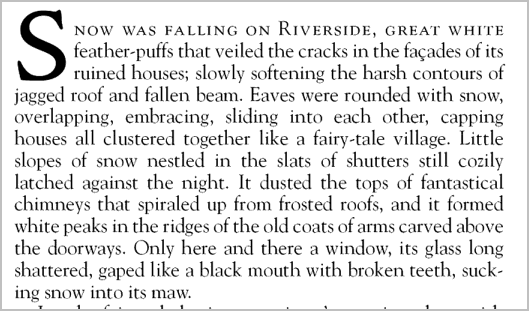
By way of contrast, the book I am currently carrying around with me is Kameron Hurley's God's War.

These are very different openings. Is one approach good and the other bad?
I think we can all agree that God's War has quite a hook--it formally declares itself as such by setting the first sentence off in its own paragraph. More than inciting curiosity, however, it also sets a tone. This is going to be a book that treats its characters and its readers roughly. The language is bald and challenging. The place names along with the desert provide a hint as to the setting's roots. This is effective, compact use of language.
As for Swordspoint... Oh. My. God. Weather! And nothing is happening. It has no identifiable hook, and current wisdom, it seems, suggests that no reader would ever get past that paragraph. However--there is more going on in it than "it's winter." Description piles up (like the snow) in a series of contrasts to create tension that can only be eased by reading on: feather-puffs/ruined, jagged/rounded, cozily/shattered. It builds a picture in your mind, promises more but makes you wait for it. The language tells you what kind of story this is going to be, that it is literary, romantic, indirect.
I think there is room in this universe for more than one approach to the opening paragraph. What do you think?
Wednesday, March 30, 2011
Limited vs Open-Ended Series
I don't often get up on a high horse and talk about writing topics, because really, who the hell cares what I think? But I've run across this topic on two blogs in the past week, and it's starting to make me crazy, so I'll blather for a while.
The posts were on the topic of writing a series, and what both of them did was gloss blithely over the inherent difference between a limited and an open-ended series, equating Harry Potter with various mystery/thriller series without ever taking note of the fact that they are comparing two different creatures. And the thing that makes a limited series different is something that is very near and dear to me: THE END.
A limited series has AN ending; it structures itself around that fact. Each part of the story evolves some distance toward that point, usually with an ascending sequence of climaxes that have the same overall rhythm as any single volume. All of the plots go to the same place. Because the previous volumes are essential--it's all one--you can limit the amount of refresher information you give readers, or section it off in an introduction. It is expected that characters, even the world will suffer major changes; that is kind of the point.
An open series has MANY endings; each book has its own. Each book's climax tends to be at the same pitch, and each new volume hits the emotional reset button. Without an end to aim for, subplots tend to proliferate; killing them off becomes a major commitment, deep-sixing a resource that could be used in future books. Either every book has an all-new major antagonist, or the major antagonist is hidden in the shadows and only his or her catspaws are defeated. The main character tends to be the draw for the entire series; therefore, it's difficult to make substantial changes to the character. Since you never know when you might pick up readers, there tends to be repeated descriptive information for new fans who don't know what the main character looks like, or what kind of car is the villain's signature.
In case you can't tell, I have very little use for open-ended series; it's one reason I hate most television (major exception: Babylon 5. Guess why.) A story that has no destination is doomed to lose its way and drown in a bog, and by the time it does that, no one will miss it.
FURY'S FLIGHT
70,000/100,000
Wednesday, March 23, 2011
Too Many Irons
It has been over a month since I've posted a blog entry. I'm not dead, or ill, nor is anyone else in the family. It's just one of those occasions on which, while trying to juggle work, family, writing, cooking, gaming, blogging, and the sundry smaller things that make up my life, I dropped a few.
In the interim I've made a lot of nice new recipes, gotten my game back onto a weekly turn schedule, survived acquisition by Oracle with most of my sanity intact, and written some more of Fury's Flight. I've revised my other novel's query and am continuing to assail the Fortress of Agents. I've totally fumbled the 365 Project.
Going to pick things up and start again.
FURY'S FLIGHT
64,000/100,000
Friday, February 18, 2011
Whew, Where to Start
I started writing this post almost a week ago. I'm just going to throw it out there before this gets even more embarrassing.
The past couple of weekends have been all about cooking. The weeks have been all about writing (and a crappy but necessary work project). There's no "where I've been" post in two weeks now because I haven't been anywhere; I've been writing. That's good. I hope. Though it is making me cranky when I get pulled away from it to do other things, and I am consumed with worry that I am going to finish my outline far shy of the wordcount I want. I am discarding a fair amount of the alpha text as I rewrite. We shall see.
On to the food. I still need to type up some recipes, but I can at least get the links out of the way. I did indeed make chicken vindaloo, and it was awesome, very close to restaurant quality. I think next time I will use thighs on the bone, and I suspect that will make them ever closer. To go with it were Penang Pickled Vegetables, or as close as I could get with what I had on hand. Those were also very good. So was the Salmon Chipotle Chowder (as you can see, it was a spicy weekend!). I would make all of these again without hesitating.
The soup project has gone off the rails a bit, even though I got some pretty new bowls from Crate & Barrel. I may get back on track this weekend, but we shall see.
And a few more photos, to catch me up. I am a bad 365er; I have missed many days now, but I'm trying.
 |
| 365 #23 Yet another view of Boston. I wanted to get the shadows, but I was talking to a co-worker and missed the time. |
 |
| 365 #24 Buying spree at Harvard Book Store |
 |
| 365 #25 Cheddar-Chive Bread via Dorie Greenspan - it rocks |
 |
| 365 #26 Dinosaurs |
 |
| 365 #27 New C&B bowls |
 |
| 365 #28 Days getting longer |
 |
| 365 #29 Miriam 4 months |
 |
| 365 #29 The trees can tell |
 |
| 365 #30 Public discussion on art restoration in the Red Line |
 |
| 365 #31 Mussel shell in a snowbank on First St., Cambridge. I have no idea. |
Monday, February 14, 2011
Core Characteristics and Emergent Properties
As usual, I have no idea how this train of thought came about, but a few weeks ago I started thinking about the core characteristic of each of my main characters, what it is that makes them uniquely themselves. For Brandon, it's duality--not just bisexuality, which is rather obvious, but his ability to move between the court and the lower city, to share foreign and home perspectives, to understand magic without being of it. Kevan took a lot longer to figure out, and the answer surprised me, because I'm pretty sure it's love. Not exactly something I planned to put into his character, but on examination, most of what he does can be traced back to that. For the new book, I'm not entirely sure yet.
That it takes a while to figure out struck me on reflection as a good thing. You want a character to be complex, to have if possible all of the inner confusions and contradictions of a real person. If you set out to write someone thinking, "this person is ambition" or whatever, you're going to wind up with cardboard, because real people don't act the same way all the time. Ask anyone to describe themselves in one word and they're likely to fidget a lot, come up with something, and then add "but" to whatever they said.
I think that this notion of a core characteristic is something that should emerge as you get to know the characters, and it's not likely to make itself known in the first draft. Once it comes out, you can shine it up in a few places if you want to, or leave it as an exercise to your future readers to argue about; if you can't come up with anything at all, though, after several drafts, that might mean that your character is not drawn clearly, or isn't being active enough to demonstrate their qualities.
FURY'S FLIGHT
13,191/100,000
Subscribe to:
Posts (Atom)